
Much depends on how the liquidity situation evolves over the coming months, with greater clarity expected from the next monetary policy meeting scheduled for December 7.

Why did the company zero in on RBL Bank to understand the business of banking? While the M&M investors heaved a sigh of relief, one gentleman must have been all smiles after this, RBL Bank MD and CEO R Subramaniakumar, notes Tamal Bandyopadhyay.

RBI on Monday conducted an unprecedented level of liquidity infusion to the tune of Rs 3.3 lakh crore, in which banks bid for as much as Rs 4.5 lakh crore. The central bank said it would conduct a liquidity infusion auction of Rs 1 lakh crore on Tuesday as well, to help banks tide over the liquidity crisis.
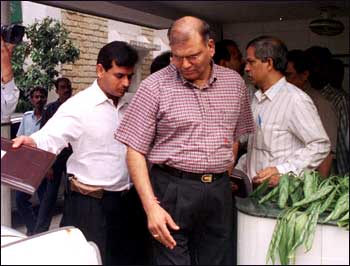
A special Central Bureau of Investigation court in Mumbai has convicted four former bank officials in one of the multi-crore securities scam cases and sentenced them to three years imprisonment, 25 years after the scam involving 'Big Bull' Harshad Mehta came to the fore.

For now, the concerns over bad loans have taken a back seat; a bigger challenge for the banking community is credit growth, explains Tamal Bandyopadhyay.

In addition to interest rates, review the fine print for penalties and repayment terms, and select a reputable lender to avoid harsh recovery practices.
The non-food component in the price basket will continue to keep inflation at a high level and result in a "long pause" in interest rates, a foreign bank said on Wednesday. The central bank is likely to pare the pandemic-driven emergency response as well, the report by Singaporean lender DBS said. It can be noted that the high inflation driven by the food prices has forced the RBI to go for a status quo in rates for the three consecutive reviews of the bi-monthly policy meetings, even as growth continues to be in the negative territory.

RBI has, since January, cut its policy rate four times.
.jpg)
Snapping a two-day fall, the rupee opened strong at 59.49 a dollar from the previous close of 59.76 at the Interbank Foreign Exchange Market and then touched a low of 59.59.
Financial services firm AnandRathi analysed the key points of the policy soon after it was announced.
.jpg)
Steps announced by new RBI Governor Raghuram Rajan could attract $10 billion of forex inflows in the next three months and this could be a material near-term positive for the rupee, which has lost 20 per cent since January, the London-based banking and financial services company said.

The 30-share Sensex closed at 19,230 mark up 283 points whereas the 50-share Nifty ended higher by 87 points at 5,699 levels.
M&M, Bajaj Auto, Tata Motors and Hero Moto and Maruti Suzuki from Auto sector surged between 1-4%.
The central bank will auction Rs 220,00 crore (Rs 220 billion) of government cash management bills every Monday, it said in a statement, without specifying for how many weeks the sales would last.

The unexpected interest rate hike by the RBI on Wednesday will have the banking system on average making a 10-15 bps gains on the yields, with private banks making larger gains as 57 per cent of their loans are linked to external benchmark rate and 40 per cent to the marginal cost of lending rates, as per a report. Stating that lenders and borrowers will face volatile times with the Reserve Bank raising the repo rate by 40 bps to 4.40 per cent and the cash reserve ratio (CRR) by 50 bps on May 4 in an off-cycle policy move, India Ratings said the market rates had already been moving higher before the move. The 364-day T-bills have moved up 120 bps and 10-year G-sec by 140 bps since May 2020, when the repo rate was cut to a record 4 per cent, which led to an expectation of a faster and sharper rise in interest rates in the system but the central bank stayed the course to support the fragile economy battered by the pandemic.

A CRR cut will help banks to reduce lending rates.
The Reserve Bank of India is likely to cut policy rates by 0.25 per cent and keep the cash reserve ratio unchanged at its policy review next week, on the back of slower-than-expected growth and more encouraging inflation readings, says a report by HSBC.

India's current account deficit is expected to deteriorate in the current fiscal on account of costlier imports and tepid merchandise exports, according to the Finance Ministry's monthly economic review. The review released on Thursday by the ministry also said that global headwinds would continue to pose a downside risk to growth as crude oil and edibles, which have driven inflation in India, remain major imported components in the consumption basket. For the present, it said, "their global prices have softened, as fears of recession have dampened prices somewhat. This would weaken inflationary pressures in India and rein in inflation."
A day after the Reserve Bank of India's (RBI's) Monetary Policy Committee hiked the policy repo rate by 50 basis points (bps), several commercial banks, including ICICI Bank and Bank of Baroda, raised their external benchmark-linked loan rates by an equal amount on Thursday. HDFC, the country's largest mortgage lender, too, increased its interest rates on housing loans by another 50 bps. In total, it has raised rates by 85 bps since May 4, when the RBI had increased the repo rate by 40 bps in an off-cycle meeting.
RBI is scheduled to announce mid-quarter review of monetary policy for 2013-14 on June 17.

In the mid-quarter review on December 18, the Reserve Bank left key policy rates unchanged but said it will hike interest rates if inflation does not subside.

SBI, the country's largest lender, first announced a rate cut of 0.25 per cent in its home loan rates on Thursday, forcing HDFC, the second biggest home loan financier, to respond.

'We have seen something do very well when the times are good but maybe not as well when the times are bad.'

The headline HSBC India Purchasing Managers' Index -- a composite gauge designed to give a single-figure snapshot of manufacturing business conditions -- stood at 54.5 in December, up from 53.3 in the prior month.

Battling a sharp surge in inflation, the Reserve Bank is all for a smooth monetary policy response and the desire to have smaller hikes led it to tighten the policy in an off-schedule meet, a source said on Thursday. Inflation has been massively impacted by Russia's invasion of Ukraine and will in due course also reflect the dent caused by Indonesia banning palm oil exports, the source aware of central bank thinking said, indicating that there was no other option but to respond. "The idea is to have a smooth policy response, not to put in large cold turkey responses," the source said, making it clear that the preference is for smaller magnitude responses and not larger ones.

That's the only way to convince those who have money to return to the bank fold, ditching other asset classes, says Tamal Bandyopadhyay.

It's always been a struggle for economists and statisticians to forecast India's gross domestic product (GDP) correctly, and say where the economy is headed before the official numbers come out. If estimating the GDP is tough, forecasting it in real time is complicated. It involves looking at tens of indicators, such as industrial production, electricity consumption and exports, to arrive at a number.

HDFC and HDFC Bank's merger - touted as India's biggest-ever corporate merger - pumped up shares of the two entities on the bourses. Shares of Housing Finance Development Corporation (HDFC) skyrocketed 9 per cent while those of HDFC Bank zoomed 10 per cent. In comparison, the benchmark S&P BSESensex and the Nifty50 indices settled 2.2 per cent higher on Monday.
Home loans of up to Rs 75 lakh (Rs 7.5 million) would now be available to fresh borrowers at 10.10 per cent against the existing rate of 10.15 per cent, State Bank of India said in a statement.
The status quo decision came as a breather as only last week the RBI had pulled up banks for not helping it in monetary policy transmission.

After Chakrabarty's exit there will be two vacancies for deputy governors in the central bank.
In a surprise move, the Reserve Bank on Wednesday left the repo rate unchanged at 7.75 per cent, while the cash reserve ratio too is retained at 4 per cent.
.jpg)
The rate cut, the industry chambers argued, could have given a positive signal to the manufacturing sector, which is undergoing difficult times.
The declining inflation and a negative industrial outlook have strengthened the case for RBI.

The move may release funds locked in government securities and add to liquidity. With inflation expectations lowered, this should not impact bond sentiment in the short run
NPCIL Chairman and Managing Director SK Jain said the company had cash reserves of over $2.75 billion to fund the equity portion of the projects, which will have a debt-to-equity ratio of 70:30. India is working on raising its nuclear power generation capacity to 60,000 Mw by 2032 against the current 4,120 Mw. Another 3,160 Mw capacity is under construction.

Concerned over inflationary pressures in the economy, the Reserve Bank of India (RBI) is bringing down surplus liquidity in the system rapidly. It has fallen to pre-Covid levels and almost 2 per cent of banks' net demand and time liabilities (NDTL). NDTL shows the difference between the sum of demand and time liabilities (deposits) of a bank (with the public or the other bank) and the deposits in the form of assets held by the other bank.
With the revision, term deposit between 180-210 days less than Rs 1 crore (Rs 10 million) would now earn 7 per cent against existing 6.80 per cent, SBI said in a statement.
The agency said the move on liquidity will lead to an ease in the situation.

Emphasising that revival of growth should be the number one priority of the RBI at this time, industry groups said apprehensions about inflation rearing its head again may prove to be misplaced.
